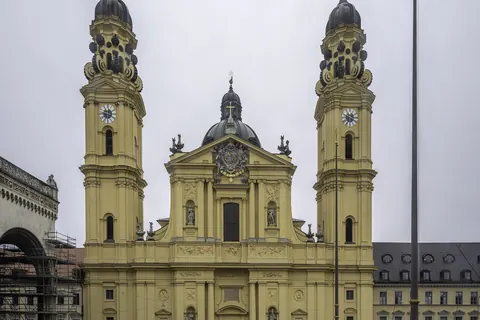
The Theatine Church of St. Cajetan and Adelaide is a Roman Catholic church in Munich, Southern Germany. Built between 1663 and 1690, it was founded by Elector Ferdinand Maria and his wife, Henriette Adelaide of Savoy, as a gesture of thanks for the birth of the long-awaited heir to the Bavarian crown in 1662, Prince Max Emanuel. Currently administered by the Dominican Order, it is also known as the Dominican Priory of St. Cajetan.
The church was built in Italian High Baroque style, inspired by Sant’Andrea della Valle in Rome, and designed by Italian architect Agostino Barelli. His successor, Enrico Zuccalli, added two towers (64.6 metres height), which were not originally included in the plans, and completed the dome (71 metres height) in 1690. The church has a length of 72 metres and width of 15.5 metres. The Rococo style façade by François de Cuvilliés was completed in 1768. The Mediterranean appearance and yellow coloring became a well known symbol for the city and had a lasting impact on Baroque architecture in Southern Germany.
Sources
- Wikipédia (fr) : Église des Théatins
- Wikipedia (en): Theatine Church, Munich
- Wikidata: Q259799
- Official website
Text: introduction of the Wikipedia article Theatine Church, Munich, under the CC BY-SA 4.0 licence (authors: article history). Facts: Wikidata (CC0). Coordinates: Wikidata, map background © OpenStreetMap contributors.